Key facts
- Distribution Network Operator: Scottish & Southern Electricity Networks (SSEN)
- Estimated solar generation: 800–1,000 kWh per kWp a year, varying by roof and location
- VAT on solar & batteries: 0% until 31 March 2027
- Finance: Interest-free credit up to £30,000, subject to status
- Typical housing: Highland croft houses, modern estates, granite and whinstone buildings
- Installation: Through MCS-certified partners
- Smart Export Guarantee: Outgoing Octopus pays 12p/kWh flat (from 1 March 2026)
Last updated: 1 November 2026
What types of properties can solar go on in Inverness?
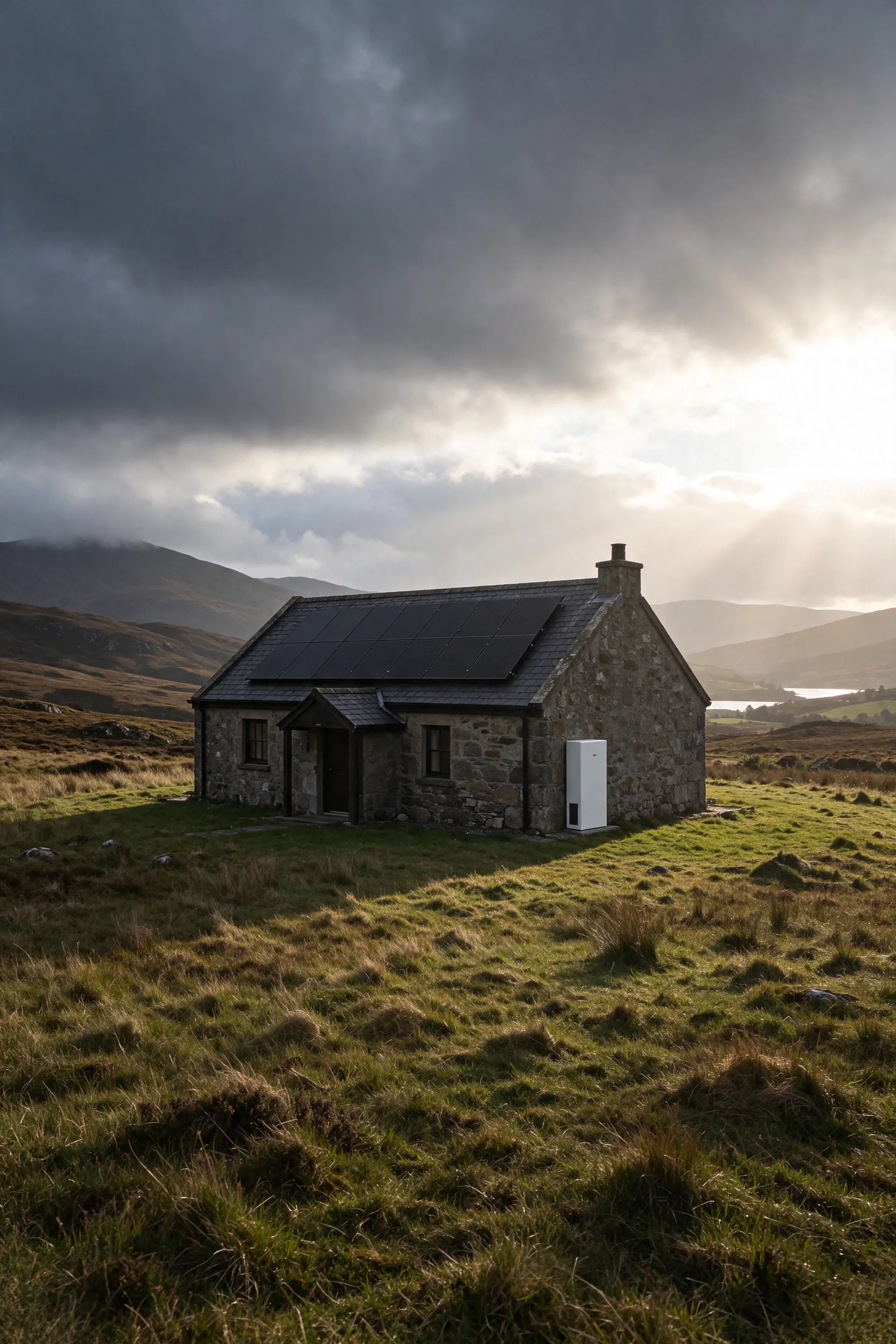
Inverness and the surrounding Highlands have a distinctive mix of traditional croft houses, granite and whinstone buildings, and rapidly expanding modern estates. Each requires a tailored approach to solar installation.
Inverness Property Types
- ✓Highland croft houses in rural areas
- ✓Granite and whinstone buildings in the older city
- ✓Modern estates in Culloden, Smithton, and Drakies
- ✓Crown and Merkinch Victorian terraces
- ✓Riverside developments along the Ness
- ✓Rural Highland stone farmsteads and cottages
Highland-Specific Considerations
- ✓Croft land and rural planning guidance
- ✓Cairngorms National Park planning restrictions
- ✓High wind exposure — enhanced fixings
- ✓Off-grid and battery-first system design
- ✓Highland Council liaison
- ✓Rural DNO connection applications (may take longer)
How do Highland weather and roofs affect solar in Inverness?
Inverness has the most extreme seasonal daylight variation of any Scottish city, with very long summer days and short winter days. Wind exposure and roof durability are key planning considerations.
Climate & Daylight
- Summer days are very long at this latitude, boosting seasonal generation.
- Winter days are short; battery storage helps carry summer surplus into winter.
- Highland winds can be strong; panels and fixings are rated for exposure.
- Estimated generation: 800\u20131,000 kWh per kWp a year, varying by roof and location.
Roof Orientation & Materials
- South-facing roofs generate most; east/west still produce around 80% of south.
- Croft house slate and stone roofs take solar well with appropriate anchors.
- Modern estate tile roofs are straightforward to fit.
- High wind areas need additional fixing points; we assess during survey.
- Ground-mount systems are an option for properties with land and limited roof space.
Which services are available in Inverness?
We offer solar panels, battery storage, heat pumps, and EV chargers across Inverness and the Highlands, installed through MCS-certified partners.
What are the key solar numbers for Inverness?
Inverness solar generates an estimated 800\u20131,000 kWh per kWp a year, varying by roof and location. Long summer days help offset shorter winter days.
What support is available for Inverness solar?
Two key incentives apply to Inverness installations, handled as part of our service.
0% VAT on Solar & Batteries
Applied automatically until 31 March 2027. No application needed.
Smart Export Guarantee (SEG)
Outgoing Octopus pays 12p/kWh flat (from 1 March 2026) for exported solar electricity. Requires MCS certification, included with every installation.
Which Inverness postcodes and areas do you cover?
We cover Inverness city, all IV postcodes, and surrounding Highland towns.
Inverness city, all IV postcodes, and the wider Highlands
Including: City Centre, Crown, Drakies, Culloden, Smithton, Balloch, Dalneigh, Merkinch, Nairn, Forres, Aviemore, Dingwall, Fort William, and surrounding Highland communities.
Do you cover areas near Inverness too?
Yes — we cover the whole of the Highlands and Moray. Nearby areas include Fort William, Elgin, Nairn, Forres, Aviemore, Dingwall, Thurso, Wick, Tain, Lochaber, and Kingussie. See our areas served page for the full list of towns across Scotland.
Inverness Solar & Energy FAQ
Yes. We cover Inverness city and all IV postcodes including the City Centre, Crown, Drakies, Culloden, Smithton, Balloch, Dalneigh, and Merkinch. We also cover surrounding Highland towns. We install through MCS-certified partners and handle croft houses and modern estates as standard.
Scottish & Southern Electricity Networks (SSEN) is the distribution network operator for Inverness and the Highlands. We handle the full G99 application and grid connection notification on your behalf, included with every installation. Rural Highland connections may take longer to process.
Yes. While winter days are short, Highland summer days are very long, which balances annual output. Panels also work in diffuse light, so overcast days still generate. Estimated generation is 800–1,000 kWh per kWp a year, varying by roof and location. Battery storage helps capture summer surplus for winter use.
Most residential solar in Inverness is permitted development and needs no planning application. Exceptions include listed buildings, conservation areas, and croft land where additional rules may apply. Properties in the Cairngorms National Park area may have stricter rules. We advise on whether consent is required.
Interest-free credit up to £30,000, subject to status. Arranged by FCA-authorised finance partners. We provide a written, itemised quote first so you know the full cost before deciding. 0% VAT on solar panels and batteries applies until 31 March 2027.
Call 0141 230 0198 or fill in our quote form. We respond within 2 hours during business hours, then arrange a no-obligation home survey to assess your roof, electrical system, and energy use. You receive a written, itemised quote with no pressure to proceed.
Last updated: 1 November 2026
Reviewed by the Scottish Energy Efficiency team